Tropical Cyclones Can Deviate from Their Tracks Even under Uniform Steering Flows
Accurate prediction of tropical cyclone tracks has long been a key priority in both scientific research and operational forecasting. Track errors directly affect assessments of wind hazards and rainfall distribution, thereby substantially undermining the effectiveness of early warnings and disaster preparedness. A recent study published in Geophysical Research Letters by researchers from the Center for Ocean Research in Hong Kong and Macau, together with a team led by Professor Jianping Gan at the Hong Kong University of Science and Technology, reports a striking finding. Even under uniform and steady steering flows, tropical cyclones can exhibit pronounced systematic track deviations.
Research Background: Are tropical cyclone motions solely determined by the large-scale steering flow?
Conventional understanding has long held that tropical cyclone motion is primarily controlled by large scale steering flows, the β effect, and topographic influences. In this classical framework, tropical cyclones are often treated as weather systems that are almost entirely advected by the background flow, analogous to a cork drifting in a stream. With continuous advances in track forecasting techniques, forecast errors have been reduced to levels approaching the theoretical predictability limit. Despite this progress, a persistent right of track bias remains evident in operational numerical weather prediction systems worldwide, with observed tracks frequently lying to the left of model forecasts. The physical mechanisms responsible for this systematic bias have remained poorly explained.
Research Method: Isolating key processes using idealized WRF simulations
Because the real atmosphere is highly complex and disentangling individual influences is challenging, the research team employed a process oriented tropical cyclone dynamical framework based on the WRF model. A series of sensitivity experiments was conducted to isolate fundamental mechanisms governing cyclone motion. In these experiments, external factors such as the β effect, topography, and land sea contrast were deliberately excluded. The simulations focused exclusively on tropical cyclone motion under uniform and steady easterly or westerly steering flows, allowing the team to examine how interactions between the vortex circulation and the background flow influence cyclone tracks.
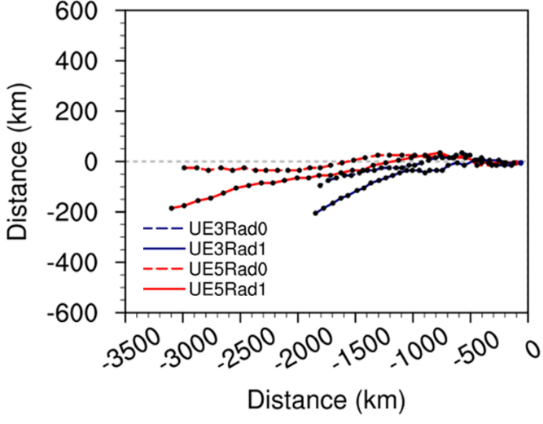
Figure 1 | Simulated tropical cyclone tracks under easterly steering flows of different strengths. Solid lines denote experiments including radiative processes, while dashed lines indicate experiments without radiation. Distances represent the displacement of the cyclone center relative to its initial position.
Key findings: Why do tropical cyclones behave like “left handers”?
The numerical simulations reveal that even in a uniform and steady background flow, strong interactions emerge between the internal vortex circulation of a tropical cyclone and the environmental flow. In the lower troposphere, enhanced convergence and upward motion develop on the southern side of the cyclone, accompanied by asymmetric convective activity. In the upper troposphere, vortex flow interactions induce pronounced asymmetries in the wind field.
As radiative diurnal forcing gradually intensifies the cyclone, these convective and dynamical asymmetries become increasingly amplified. Ultimately, the resulting asymmetries modify the horizontal advection and diabatic heating terms in the potential vorticity tendency, leading to a persistent leftward track deflection. This behavior gives rise to a systematic “left handed” bias in cyclone motion.
Research highlights
- Even under uniform and steady steering flows, and in the absence of the β effect and topographic influences, tropical cyclone tracks can exhibit systematic leftward deviations.
- The leftward deflection arises from flow vortex interactions that generate asymmetric convection and wind structures, which in turn modify horizontal advection and diabatic heating in the potential vorticity tendency.
- Radiative effects further enhance these asymmetries, strengthening the track deviation.
-
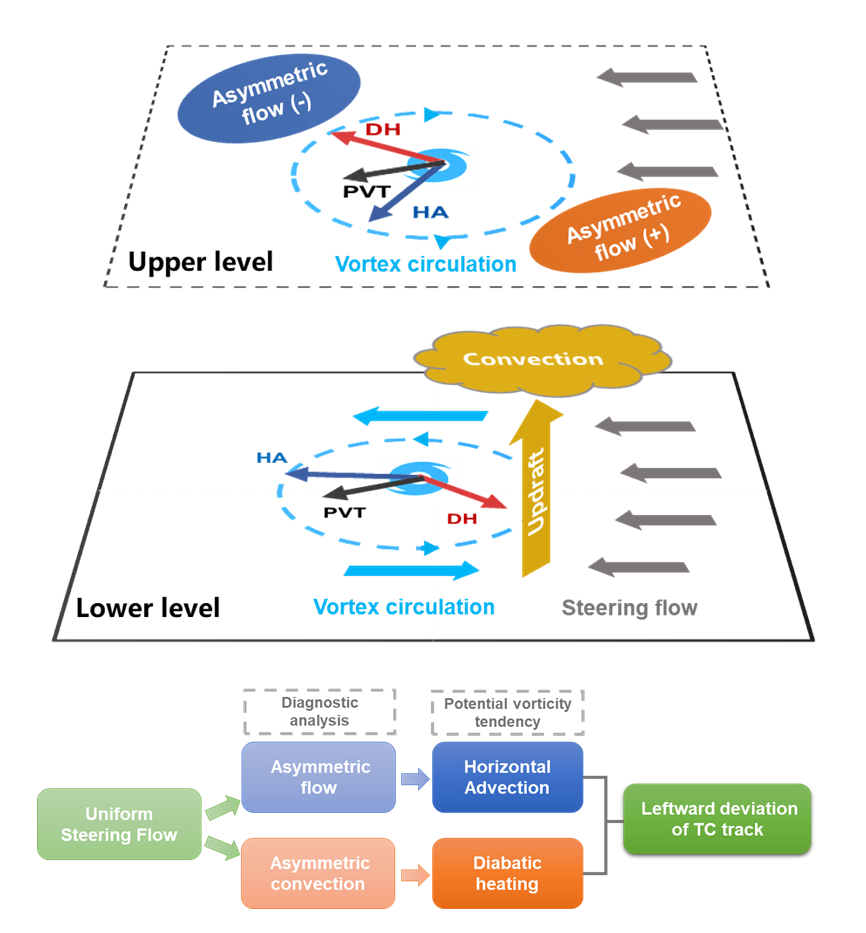
Figure 2 | Schematic illustration of the physical mechanisms responsible for leftward tropical cyclone track deviations under uniform background flows. Asymmetric vorticity anomalies in the upper level wind field, enhanced low level convection, and associated potential vorticity tendency terms collectively drive the track shift
Scientific significance
This study demonstrates that theories relying solely on large scale steering flows are insufficient to explain all tropical cyclone track deviations. Small scale internal processes, including convective organization, asymmetric wind structures, and radiative diurnal effects, can exert dynamical influences comparable to those of the β effect or topography, thereby altering cyclone motion.
If numerical models fail to accurately represent these asymmetries, systematic forecast biases, such as the long standing right of track error, are likely to persist. As track prediction skill continues to approach its theoretical limit, these processes, once considered secondary, are emerging as critical factors for further improving tropical cyclone forecast accuracy.
For more detailed spatiotemporal feature analysis, please refer to: Zhong, Q., Gan, J., Shi, D., Tu, S., & Chan, J. C. (2026). Do Tropical Cyclones Have a Steady Translation Under a Uniform Steering Flow?. Geophysical Research Letters, 53(2), e2025GL119479. https://doi.org/10.1029/2025GL119479.